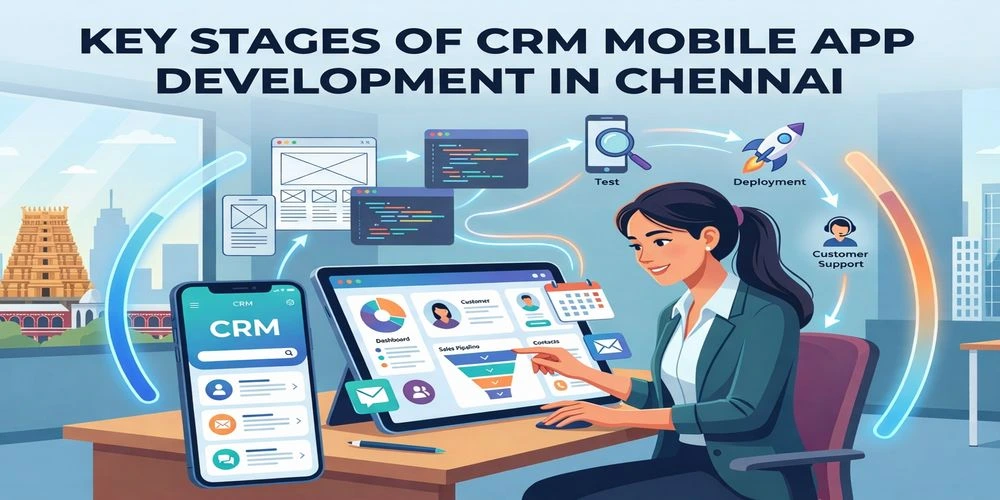
Key Stages of CRM Mobile App Development Company in Chennai
Last month, a sales manager from a mid-sized logistics firm in Chennai shared something interesting. His team had a CRM Mobile App Development Company in Chennai, a proper one, with all the modules. But when his executives were out visiting clients, they were still taking notes on paper and updating the system later that evening from their desktops. Two deals slipped that quarter because follow-ups were logged too late.
That story is more common than most business owners admit. The CRM works. The team just cannot use it where the actual work happens. This is the gap that a CRM mobile app fills, and filling it properly requires more than just making a desktop system look smaller on a phone screen. It requires a development process that is thought through from the very beginning. Here is how that process works, stage by stage.
Here Is Why Choosing the Right CRM Software in Chennai Shapes Everything Your Mobile App Becomes
The first stage is not design. It is not coding. It is listening.
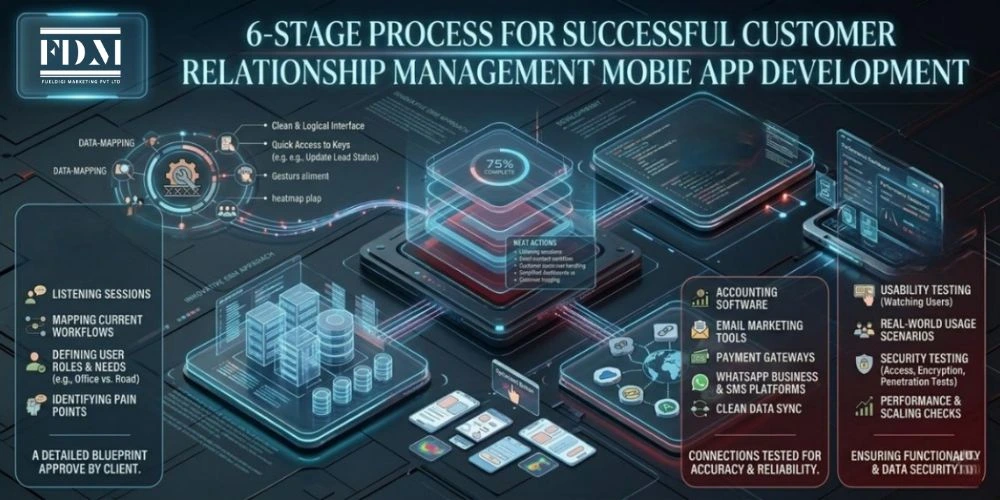
Every CRM mobile app project at FuelDigi starts with a detailed discovery session. The development team sits with the client, sometimes across multiple meetings, and maps out the real picture. Who uses the CRM daily? What tasks do they perform in the office versus on the road? Where does communication break down? What does a sales executive actually need when they are sitting across from a prospect?
These questions sound simple. The answers are anything but. A retail business and a healthcare company both need lead tracking, but the way their teams work, the data they capture, and the decisions they make on the move are completely different. One size does not fit either of them properly.
Once the discovery is done, the team moves into requirement documentation. Every workflow is written down. Every module is listed. Every user role is defined. This document becomes the blueprint for everything that follows, and it is reviewed and approved by the client before development begins.
- Stage Two: Architecture and Technical Planning
This is where the technical team decides how the app will be built. Key decisions made here include how the mobile app communicates with the central CRM database, how data is stored when the user has no internet connection, how the app handles simultaneous users without slowing down, and how new features will be added later without breaking what already exists.
Getting this right early prevents expensive problems later. Many CRM Software in Chennai failed not because the features were wrong but because the foundation was weak, and when the team grew or the business changed, the app could not keep up.
- Stage Three: UI and UX Design
A CRM used on a phone is used differently from a CRM used on a desktop. The screen is smaller, the user is often in the middle of something else, and they need to complete tasks quickly. A field executive updating a lead status should not need six taps to do it.
The design stage focuses on creating an interface that is clean, logical, and fast to navigate. Dashboards are simplified for mobile screens. Forms are shortened. The most-used actions are placed where they are easiest to reach. The evaluation of each screen includes an assessment of its visual appearance and its performance during actual usage tests.
- Stage Four: Development and Module Building
The established development phases control the development process. The system development begins with its fundamental modules which include lead management, contact records, task tracking, pipeline visibility, and basic reporting functions. The entire system undergoes building and testing, after which developers create the core system.
The complete system consists of the quotation and invoice viewing module together with multiple components which include customer support ticketing, expense logging, WhatsApp and email integration, notification alerts, offline sync, and custom reporting dashboards. Each module undergoes testing during its development process instead of waiting until the complete system development concludes.
- Stage Five: Integration With Existing Tools
Most businesses already use other platforms, accounting software, email marketing tools, payment gateways, WhatsApp Business, and SMS platforms. The CRM mobile app needs to connect with these cleanly, so data does not have to be entered twice, and communication is automatically logged against the right contact.
Integration work requires extensive effort because it needs detailed documentation and testing. The testing process evaluates each connection to determine its accuracy and reliability and performance capabilities. A notification that fires at the wrong time or a payment status that does not sync correctly can cause real operational problems so this stage is never rushed.
- Stage Six: Testing Across Devices and Scenarios
Testing a CRM mobile app means more than checking that buttons work. It means giving it to actual users with no training and watching where they get confused.
At this point, security testing is also essential. Customer data, pricing information, internal communications, all of it lives inside the CRM. Role-based access is confirmed. Data encryption is checked. Penetration tests are run to identify vulnerabilities before the app goes live.
What Sets FuelDigi Apart From Other CRM Companies in Chennai When It Comes to Mobile App Development?
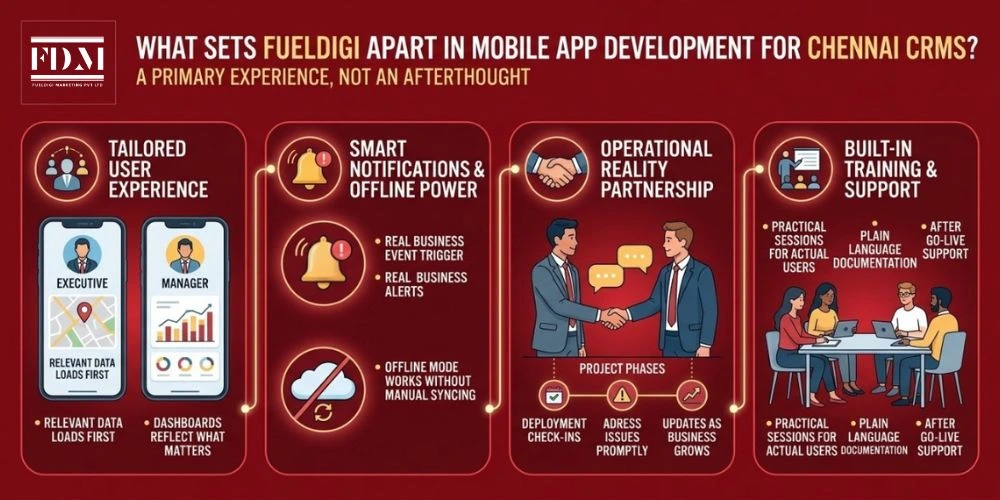
Out of all the CRM companies in Chennai, almost all offer mobile access as a feature. FuelDigi treats mobile as a primary experience, not an afterthought.
Field executives get an app that loads their most relevant data first. Managers get dashboards that reflect what actually matters to them. Notifications are triggered by real business events, not generic system alerts. Offline mode works without constant manual syncing.
Clients working with FuelDigi get more than a delivered product. They get a team that understands the operational reality behind the software, one that checks in after deployment, addresses issues as they surface, and updates the system as the business grows.
Training is built into every project. The team does not hand over the app and disappear. Practical sessions are conducted with actual users, documentation is provided in plain language, and support is available after go-live.
Conclusion
A CRM mobile app built without a proper process is just an expensive shortcut that creates new problems. The stages described here, discovery, architecture, design, development, integration, testing, and deployment, exist because each one removes a specific risk from the final product.
FuelDigi has delivered CRM mobile apps to businesses across logistics, healthcare, retail, education, finance, and IT services. The process is the same every time. The output is always specific to the client.
If your team is still updating records after the fact, chasing data across tools, or working from memory when they are away from their desks, a properly built CRM mobile app changes that completely.