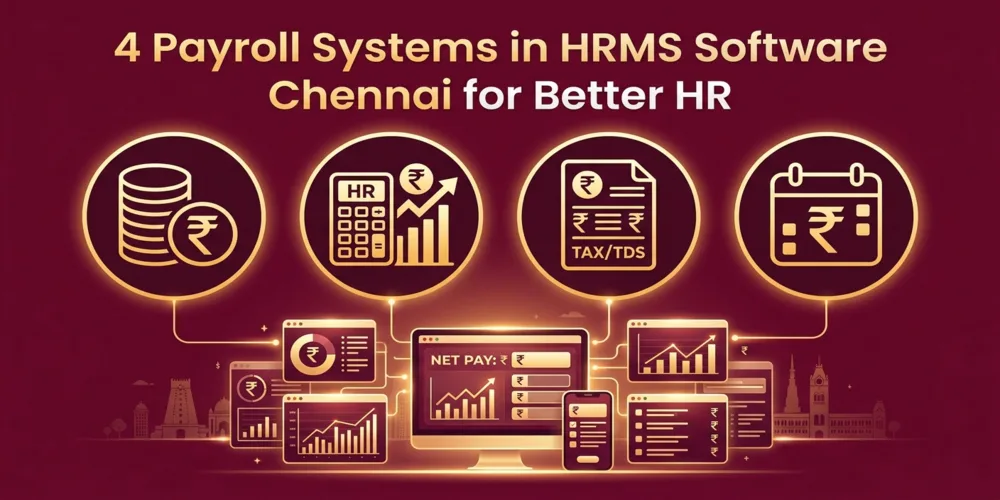
4 Payroll Systems in HRMS Software Chennai for Better HR
Priya handles the HR role for a mid-sized logistics company in Chennai. Every month, around the 25th, her calendar fills up with one thing: payroll. She pulls attendance data from a biometric system that exports to Excel. She checks the leave register maintained separately by team leads. She cross-references both against the master salary sheet she built three years ago. Then she calculates PF, ESI, TDS, and professional tax manually because the formulas break whenever someone joins or exits mid-month.
By the time she finishes, two to three days have passed. There are almost always one or two errors that come back through employee complaints. And then she does it all over again next month.
When Priya’s company was purchased by HRMS Software Chennai, the first full payroll cycle after implementation took four hours. Not two days. Four hours. Zero complaints. Zero errors.
That shift did not happen because the software was impressive on a demo screen. It happened because four specific payroll systems inside the HRMS started working together with systems that had been broken and disconnected for years.
How the Right HR Software in Chennai Connects These Four Payroll Systems Into One Working Process
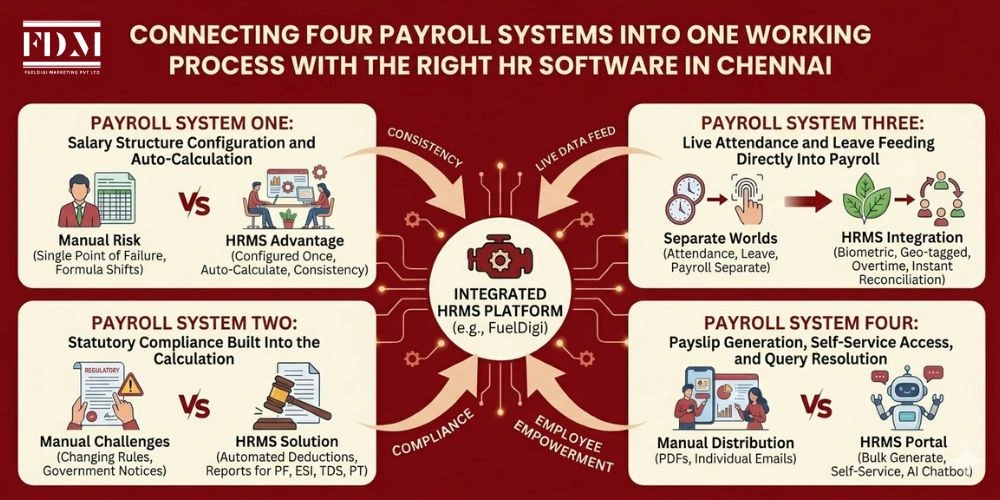
Payroll System One — Salary Structure Configuration and Auto-Calculation
In most Chennai companies running payroll manually, the salary sheet is owned by one person. They built it, they understand it, and when they go on leave, nobody touches it. That single point of failure creates a serious risk every month.
A properly built salary calculation engine inside an HRMS removes that dependency entirely. Salary components, basic pay, HRA, transport allowance, special allowance, variable pay, deductions, and reimbursements are configured once inside the system. Based on consideration of designations and grades, all individual employee profiles are to be mapped to their appropriate salary structures.
From that point, every payroll cycle is calculated automatically. When an employee receives a salary revision, HR updates the profile, and the next cycle reflects it. When a new joiner arrives on the 18th, the system calculates their exact pro-rated salary without anyone doing the arithmetic separately.
Every calculation follows the same logic every time. No version where one person calculates differently from another. No month where a formula shifts because a row was inserted in the wrong place on a spreadsheet; four people have edited over three years.
Payroll System Two — Statutory Compliance Built Into the Calculation
PF, ESI, TDS, and professional tax are legal obligations, not optional line items. Getting them wrong, even slightly, creates problems that arrive months later as government notices, penalties, and time-consuming reconciliation work.
The challenge with manual statutory compliance is that rules change. PF wage ceiling thresholds, ESI applicability limits, and TDS slabs; these are updated through notifications that HR teams may not catch immediately. A manual spreadsheet only updates when someone remembers to check and apply the change correctly.
The HR Software in Chennai payroll engine operates its primary function to handle all statutory compliance needs.
Statutory reports, PF challans, ESI returns, Form 16, and professional tax filings are generated directly in the correct submission format. No manual compilation. No reformatting before an audit. Everything is accurate and ready from the moment payroll closes.
Payroll System Three — Live Attendance and Leave Feeding Directly Into Payroll
This is the system that saves the most time when it works and causes the most errors when it does not.
In most organisations, attendance and payroll are separate worlds. Attendance sits in one tool. Leave records live in another register. Payroll runs in third place. Every month, someone manually reconciles all three checking attendance against approved leave, calculating loss of pay, adding overtime, and adjusting for mid-month joiners and exits.
When attendance and leave management live inside the same HRMS as payroll, that entire reconciliation disappears. Biometric check-ins and geo-tagged attendance feed directly into the attendance module. Team leads approve leave within the same system. Overtime is captured automatically based on shift schedules.
When payroll runs, it reads all that data instantly. Loss of pay reflects actual verified records. Overtime additions, late-mark deductions, and leave encashments are processed without anyone moving numbers between spreadsheets.
FuelDigi’s HRMS connects with biometric devices, mobile geotagged attendance for field teams, and face recognition systems, all feeding the same attendance engine that payroll reads from every cycle.
Payroll System Four — Payslip Generation, Self-Service Access, and Query Resolution
Processing payroll accurately is only half the responsibility. Getting that information to every employee clearly, on time, with a full breakdown is the other half that most organisations still handle poorly.
Manual payslip distribution is its own monthly project. Generating PDFs, naming files, sending individual emails, tracking who received theirs, then handling calls from employees who did not get theirs or do not understand a deduction.
A self-service portal built into the HRMS removes all of it. The moment payroll is approved, payslips are generated in bulk and pushed to every employee’s account automatically. Employees log in from their phone or desktop, view their current payslip, download previous ones, check their salary structure, and raise a query if something looks incorrect, all without contacting HR.
FuelDigi’s HRMS also includes an AI-powered HR chatbot that handles routine queries, leave balance, payslip status, and policy clarifications without HR responding manually to each one. For teams managing large headcounts with limited HR staff, this alone reclaims meaningful time every week.
Why FuelDigi Builds the Best HR Software in Chennai for Organizations That Need Payroll Done Right
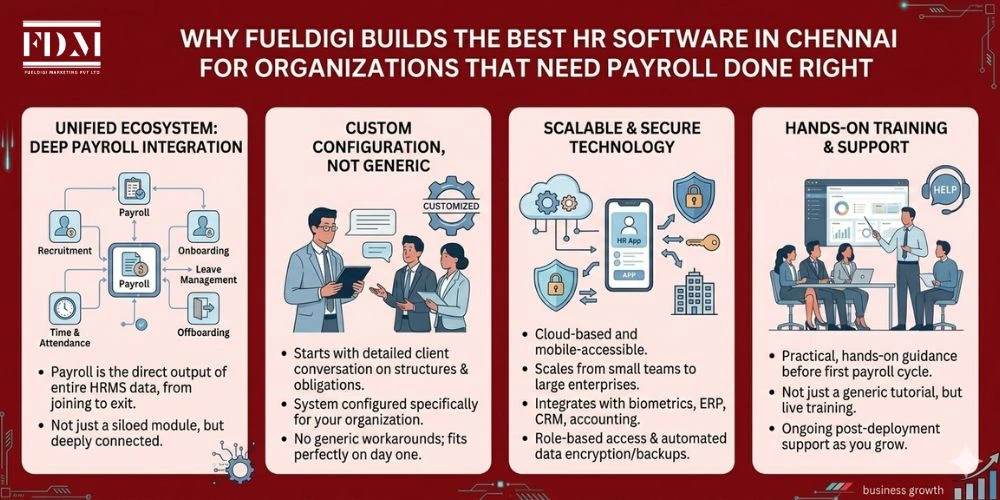
What separates FuelDigi from other HR software providers in Chennai is how deeply these four payroll systems connect with the rest of the HRMS. Payroll is not a module sitting next to the others; it is the direct output of everything the system captures from joining to exit.
Every implementation starts with a real conversation about the client’s salary structures, statutory obligations, workforce categories, and daily pain points. The system is configured for that specific organisation. Nothing is generic. Nothing requires workarounds on day one.
The top HR software solution available in Chennai operates as a cloud-based system that users can access through mobile devices and which supports business growth from small teams to multiple office locations. The system establishes connections with biometric systems ERP software CRM platforms and accounting applications. The system uses role-based access to restrict payroll data visibility to authorized personnel only. All data is secured through cloud servers which use encryption and automated backup systems to protect stored information.
Training is part of every delivery. HR teams get practical, hands-on guidance before the first payroll cycle runs, not a recorded tutorial sent over email. Post-deployment support continues as the organisation grows.
Conclusion
Payroll errors cost time, create compliance risk, and break the trust employees place in the organisation that pays them. The four systems here, automated salary calculation, statutory compliance, live attendance integration, and self-service payslip distribution, work together to make errors structurally unlikely rather than just occasionally avoidable. Priya’s company stopped dreading the month-end. Yours can too. Contact FuelDigi today and get an HRMS built around your payroll process, not a generic template your team has to adapt around.