
7 Pillars to Choose the Best Ecommerce Company in Chennai
Most businesses in Chennai that approach us have already wasted money on a bad ecommerce project. They hired someone based on a low quote or a slick Instagram page, got a half functional website delivered three months late, then spent another six months fixing what should have been right from day one.
Choosing the wrong Ecommerce Company in Chennai does not just cost money. It costs time, momentum, and customer trust three things that are genuinely hard to rebuild once lost.
So before you send that first enquiry, here are seven things worth evaluating carefully. Not as a theoretical checklist as real filters that separate companies worth trusting from ones worth avoiding.
That story is more common than most business owners admit. The CRM works. The team just cannot use it where the actual work happens. This is the gap that a CRM mobile app fills, and filling it properly requires more than just making a desktop system look smaller on a phone screen. It requires a development process that is thought through from the very beginning. Here is how that process works, stage by stage.
Ecommerce Website Development in Chennai -7 Pillars Worth Your Consideration Before Deciding
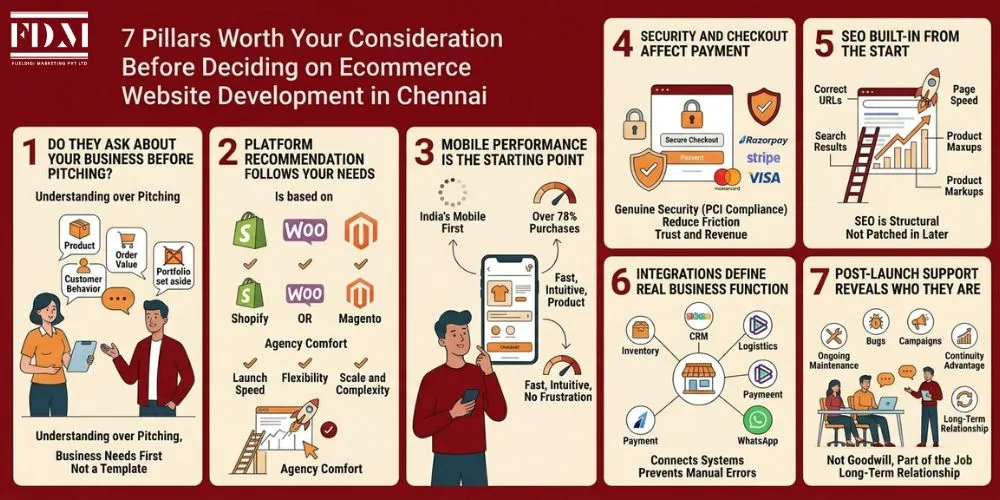
- Do they ask about your business before pitching their services?
This is the first and most revealing sign. When you call or meet an ecommerce agency, pay close attention to who is doing most of the talking in that first conversation.
A good team asks questions. What are you selling? What is your average order value? Do you have seasonal demand spikes? Who is your customer age, location, buying behaviour? How are people currently finding you?
If they spend the first thirty minutes showing their own portfolio without asking a single question about your business that tells you everything. They are selling a product. They are not solving your problem. Proper ecommerce website development in Chennai starts with understanding what your business actually needs, not fitting your brand into a template that already exists on their server.
- Platform recommendation should follow your needs — not their comfort
Shopify, WooCommerce, Magento each serve a different type of business well. Shopify suits brands that want to launch quickly without heavy technical maintenance. For those WordPress-powered operations looking towards flexibility, WooCommerce fits well. Magento handles large-scale catalogues with complex pricing and multi-warehouse logic.
A trustworthy agency evaluates your situation and recommends accordingly. If every single client they have is on the same platform regardless of business type or size they are optimising for their own convenience, not your growth.
- Mobile performance is not a feature — it is the starting point
Over 78% of online purchases in India happen on mobile. That number is not reversing.
When you review an agency’s portfolio, do not just look at desktop designs. Open their client sites on your phone. How fast do they load? Is the navigation intuitive? Can you go from product page to checkout without frustration?
A site that looks great on a desktop monitor and performs poorly on a mid-range Android phone will lose customers quietly. Most visitors will not tell you why they left. They simply will not return.
- Security and checkout design directly affect whether you get paid
The checkout page is where money either enters your account or disappears. A poorly structured payment flow, an unfamiliar gateway, a missing security indicator, these small things create doubt in a customer’s mind at exactly the moment they need to trust you.
Look for agencies with genuine experience implementing PCI-compliant systems, integrating gateways like Razorpay or Stripe, and building checkout flows that reduce friction at every step. Fewer clicks. Clear progress indicators. Saved address options. These details compound into real revenue differences over time.
- SEO needs to be built in from the start — not patched in later
This is one of the most expensive lessons businesses in Chennai learn after launch.
SEO is structural. It lives in how your URLs are built, how fast your pages load, how product data is marked up, how internal links are organised. If an agency finishes your store and then says “do you want to add SEO now?” The problem has already happened. Fixing structural issues after delivery means reworking code that should have been correct from the beginning. An in-house SEO marketing team comes along as really a rarity in website development jobs; generally, a proper agency inculcates SEO within the system, not as a value-added service but as protocores.
- Integrations define how your store functions as a real business
Your ecommerce website cannot operate in isolation. It needs to communicate with your inventory system, CRM, logistics partner, WhatsApp business account, email platform, and analytics tools.
When these systems connect properly, your team moves faster, your customer experience improves, and manual errors drop significantly. When they do not connect, you end up with people manually copying order data between spreadsheets late at night. Ask every agency you consider: have they previously integrated tools like Zoho, ShipRocket, or Razorpay for clients? How they answer that question tells you a great deal about their actual experience versus what their website claims.
- Post-launch support reveals who the agency really is
Websites need maintenance. Bugs appear. Products change. Campaigns require new landing pages. The agency that stays available and responsive after your store goes live is the one worth building a long-term relationship with.
Post-launch support is not goodwill. It is part of the job. And if that same company also manages SEO, paid advertising, social media, and content marketing that continuity becomes a genuine advantage. One team understanding your full picture is always more effective than managing five separate vendors with no shared context.
Ecommerce Website Development Company in Chennai — This Is What FuelDigi Actually Does
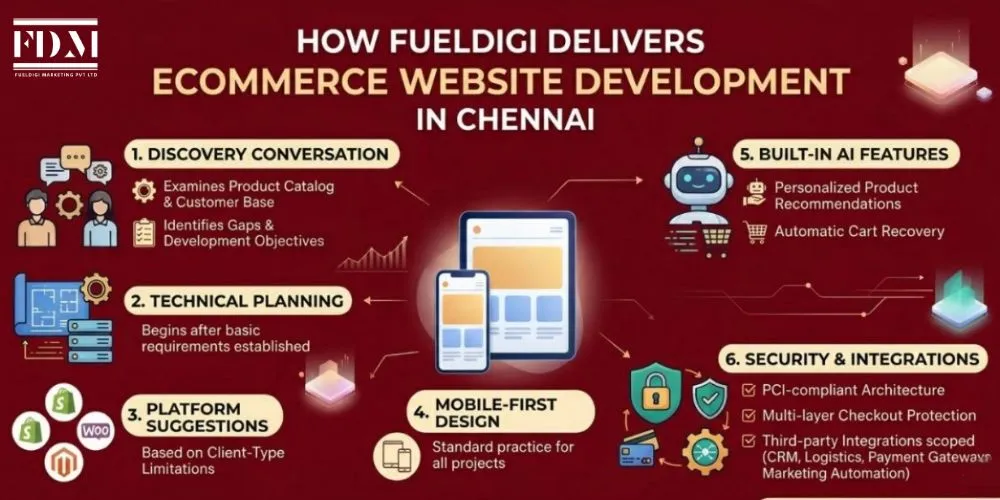
FuelDigi Marketing operates from Thoraipakkam, Chennai. Their approach to Ecommerce Website Development Company in Chennai is meaningfully different from most agencies in the city.
- A discovery conversation starts every project to examine your product catalog and customer base and to identify existing gaps and future development objectives.
- The technical planning process begins after the basic requirements of the project have been established.
- Based on the actual client-type limitations, the team offers suggestions for the implementation of Shopify, WooCommerce, and Magento platforms.
- The development team implements mobile-first design as their standard practice for all projects.
- The system provides built-in AI features which offer personalized product recommendations and automatic cart recovery as standard system functions.
Conclusion
FuelDigi also handles digital marketing in-house: SEO, PPC, social media, and content. The team that builds your store is the same team growing your visibility. Nothing gets lost between departments.For businesses serious about competing in Chennai’s online market, this is where that conversation starts.